One call. The whole deal, for both sides.
Paste the transcript of a sales call. Your team gets the verdict, the next move, who decides and every commitment with the words it came from. Your client gets a recap they can act on. Nothing goes out until you send it.
No bot joins the call. Works with the recorder you already use.
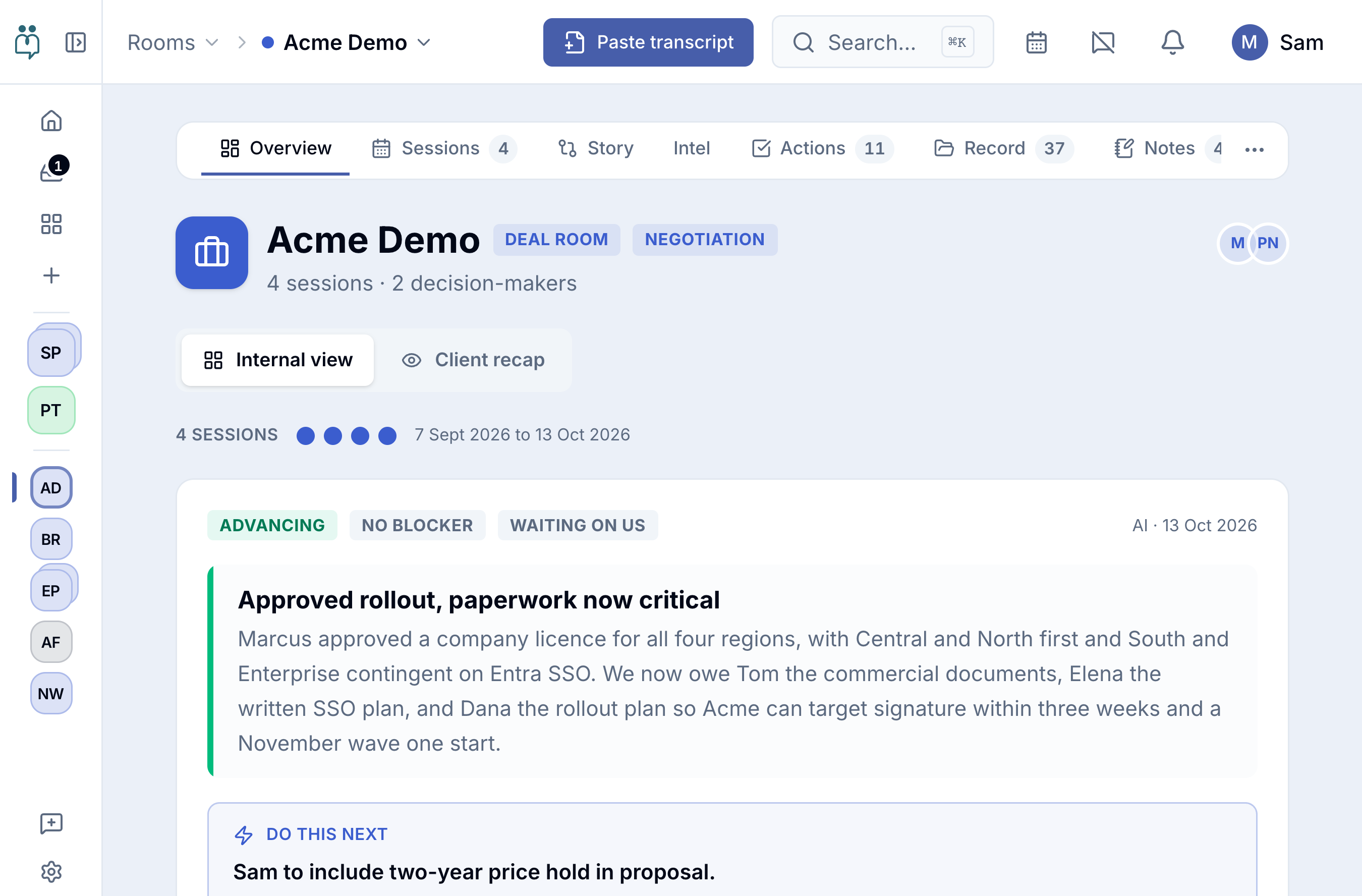

Every action names who, by when, and the exact words it came from.
Clients act on their plan without an account. Internal notes stay inside.
Paste, forward or connect the recorder you already use.
Who is waiting on you and what you're owed, before nine.
What runs when you paste a sales call
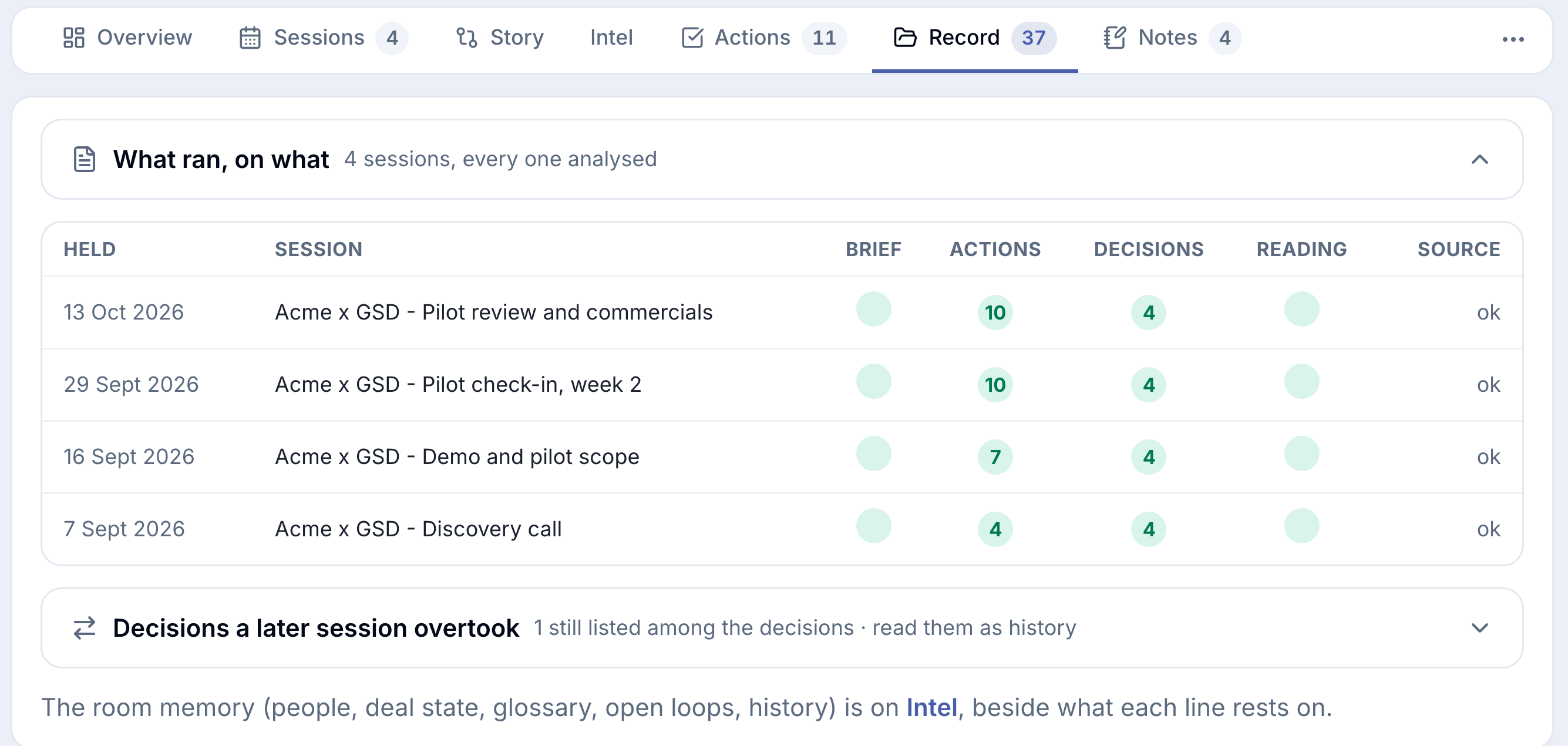
The Record tab after four sessions. Every column is a pass that ran; every dot is a check that passed. When something fails, it says so here, with one fix.
The transcript is kept as the record before anything else happens. Then the title, the real meeting date, who was there and whether they spoke, each with the line that proves it.
Actions at altitude: outcomes first, then the steps under each. Decisions and notes. Then the sales pass: the client half, the internal half and a typed reading of the deal.
Each signal, moment and action carries a verbatim anchor, checked against the transcript. A "client quote" your own side said is dropped. Nothing is invented.
Proposed actions arrive on a review board with the line each came from. Claim, counter, reassign or drop. Then Lock and publish: that starts the clock.
Everything you get from one session.
In the order you'll use it. Internal insights stay in the room. Client-visible ones go out only when you send them.
Where the deal stands, in three words you can hover.
Every session produces a typed reading. Three chips, each backed by the exact line that justifies it. Then "Do this next": the first open loop that's ours, or the step you set by hand.
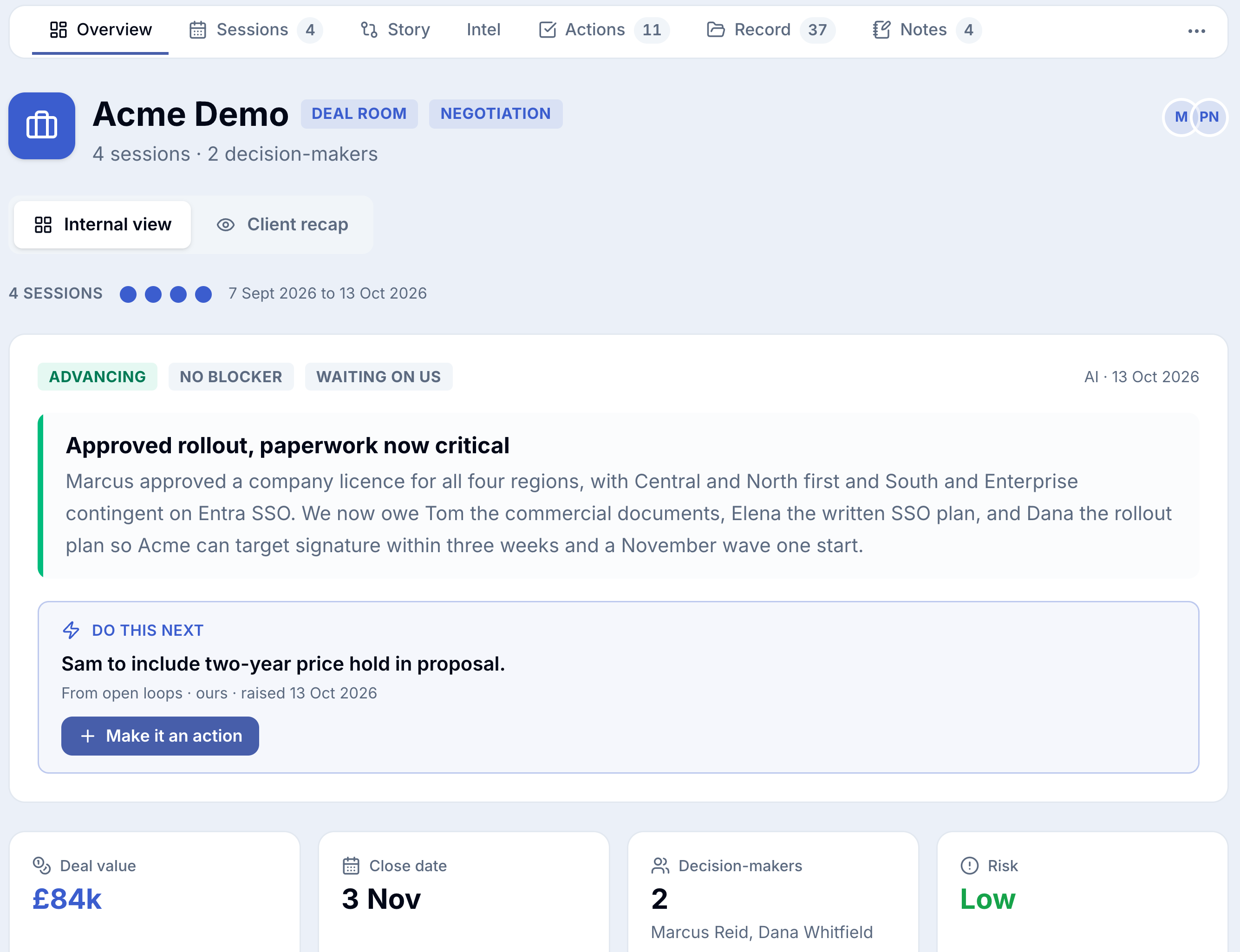
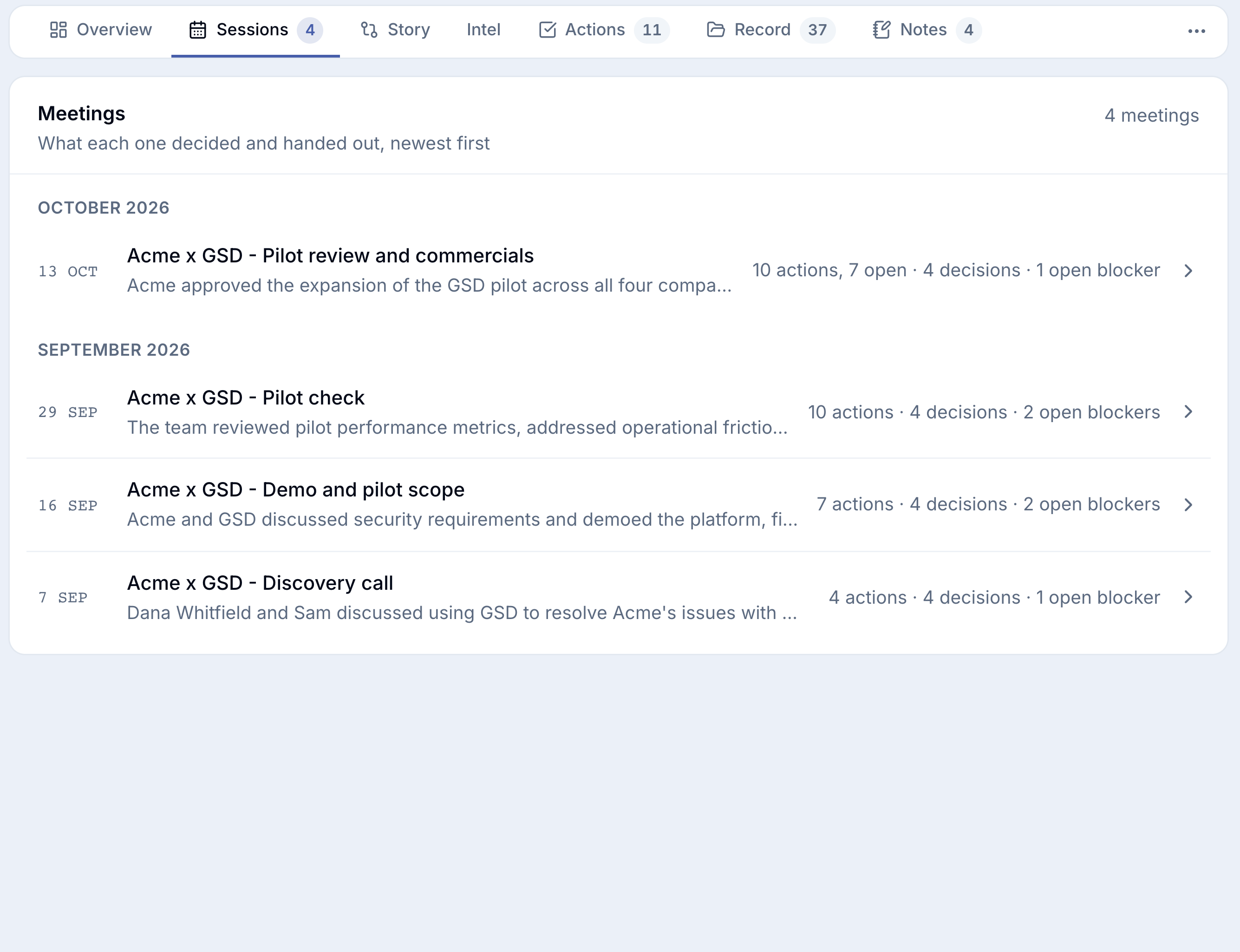
The record grows with every call. The brief is rewritten after each one.
Sessions: every meeting with what it decided and handed out: actions, decisions, open blockers.
Deal brief: where this deal is, in three to seven themes, with the full state underneath. Open loops tagged ours, theirs or shared, each with its action or a one-click way to add one.
Deal facts: value, close date, decision-makers and risk, set by you. MeetApp.ai nudges when they go stale.
What we know about Acme. Every line opens where it was said.
Built across every meeting in the deal. Buyer, champion, what stops them, whether budget was discussed, how they decide, their window. Then who decides and how to work with each person, what they said meeting by meeting, and quotes you can use.
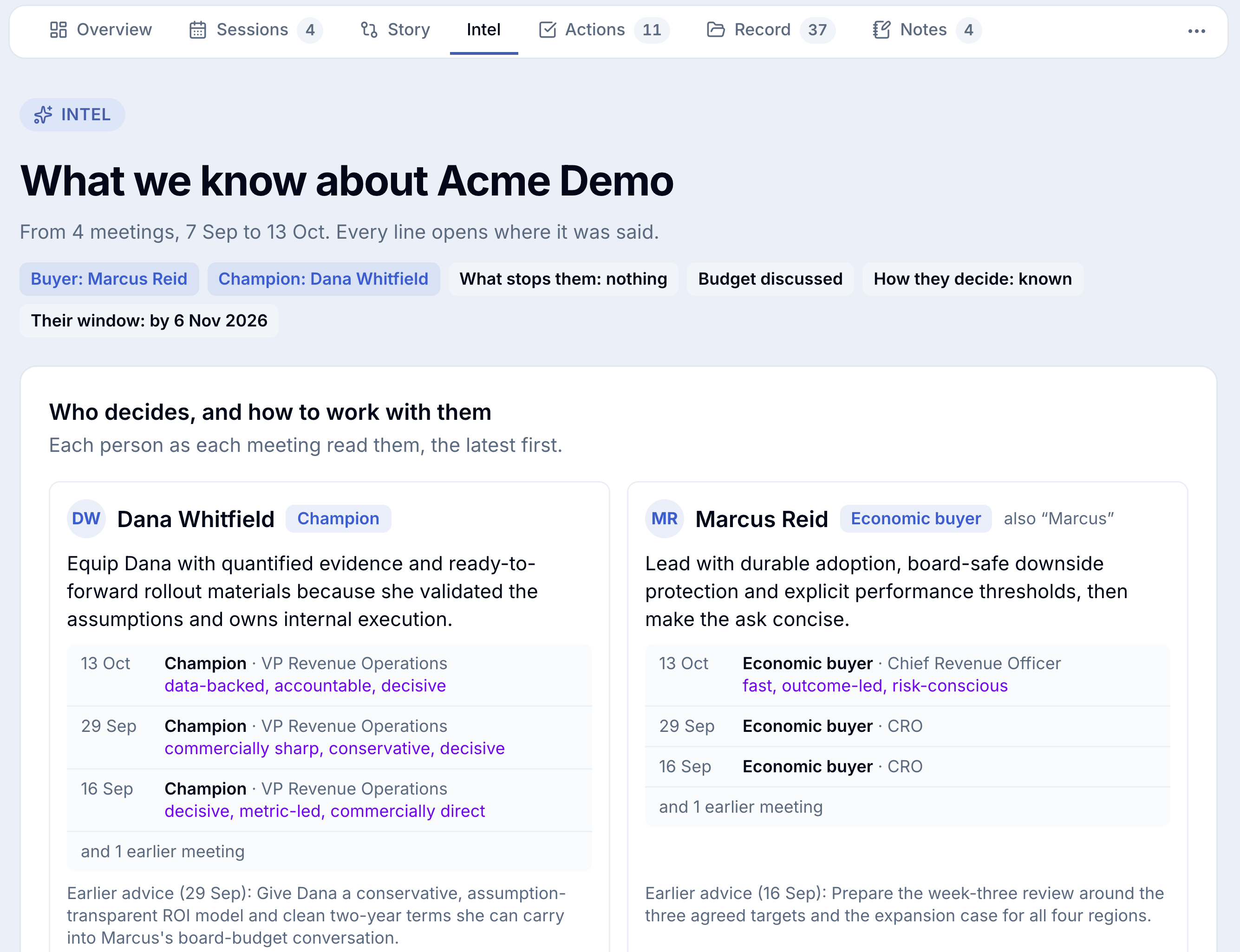
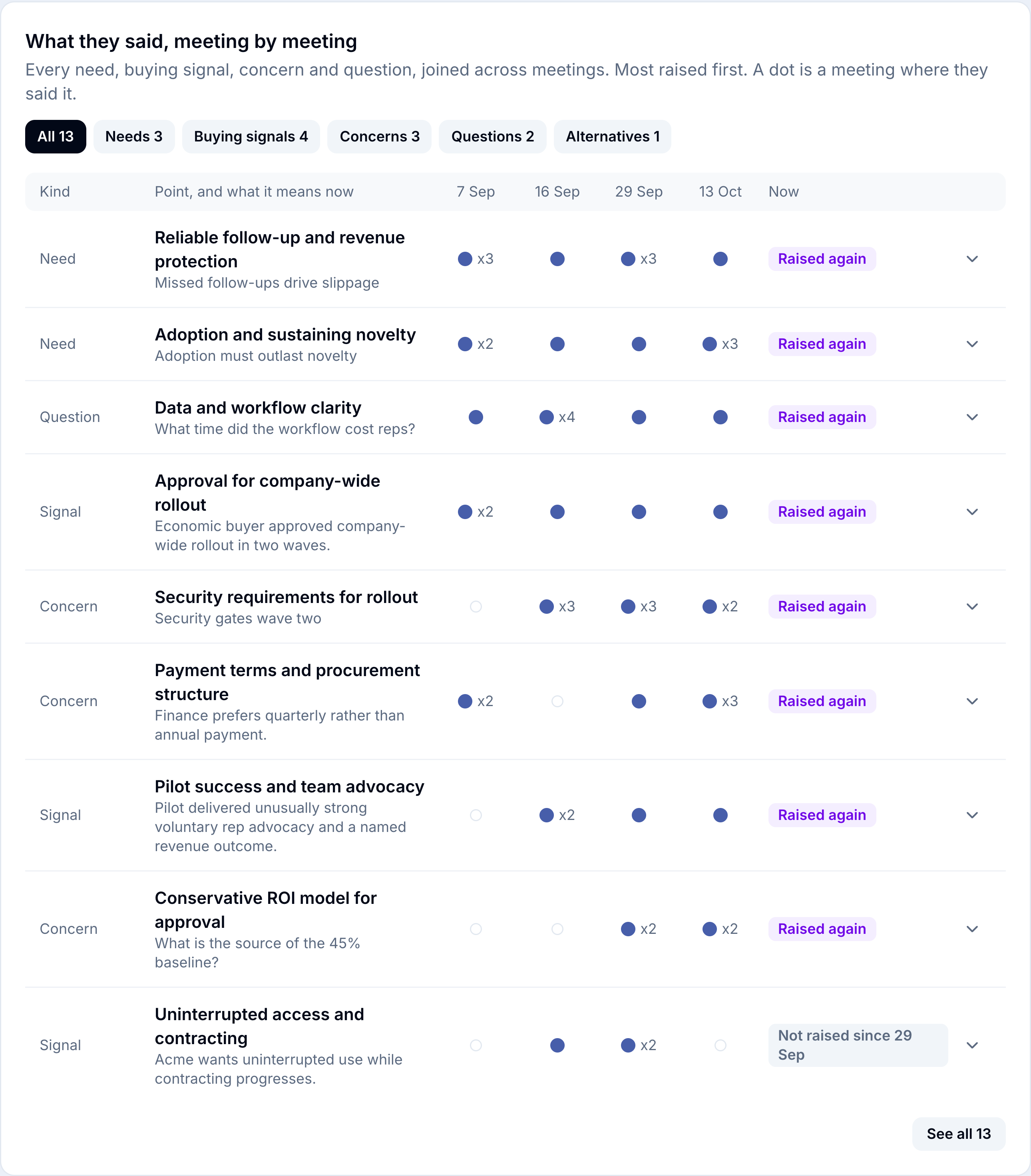
The client's own words, joined across every meeting.
Every need, buying signal, concern, question and alternative the client voiced, as one thread across the whole deal. A dot for each meeting it came up in. A status only a multi-meeting record can give: New, Raised again, or Not raised since.
A note-taker summarises one call. A CRM holds what the rep typed. This is the difference between "I think they're worried about price" and "They raised price on 29 September and haven't since." Lines your own side said are dropped before they can be mistaken for the client's, and every row opens where it was said.
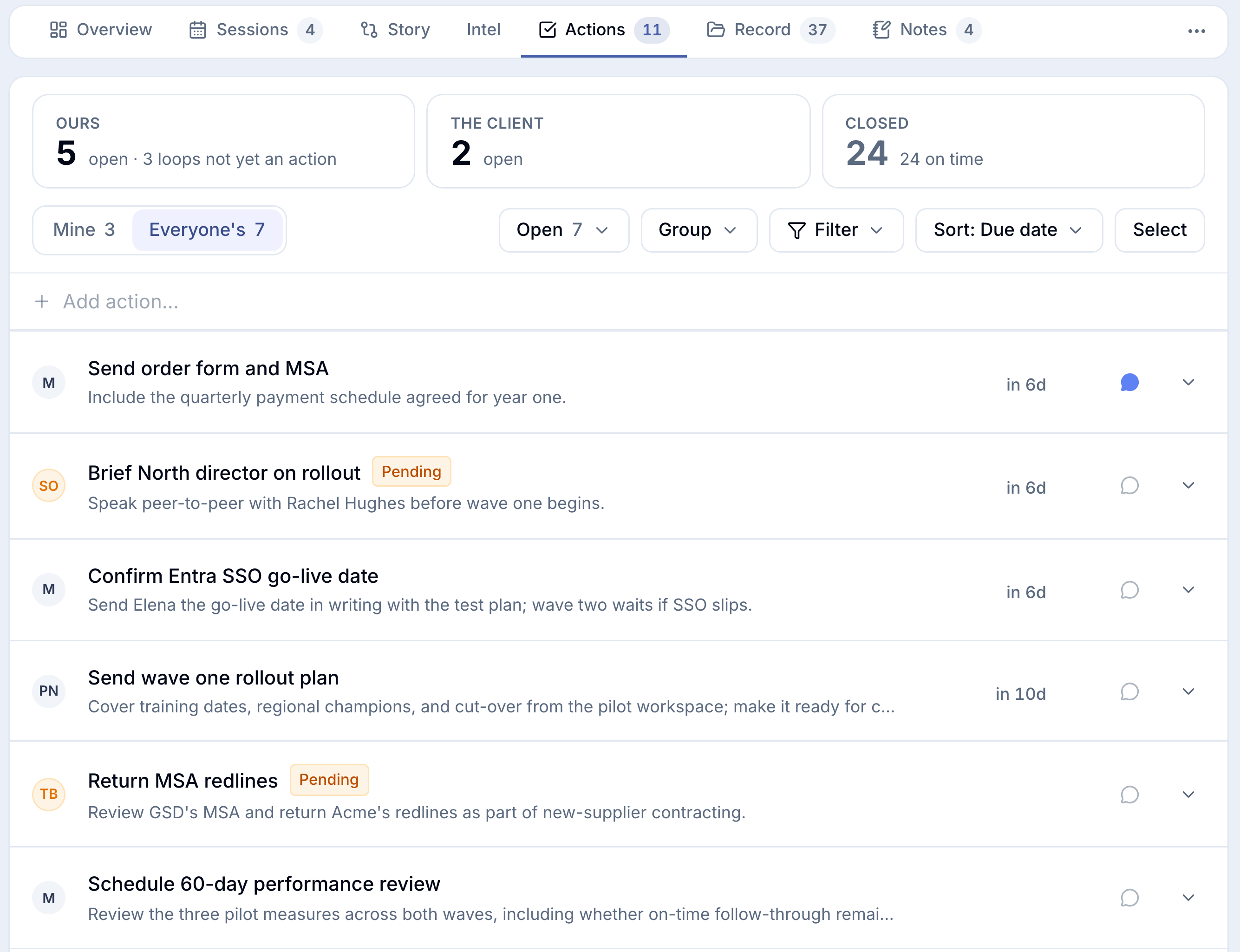
Every promise, with a name, a date and the words it came from.
Up to eight outcomes per call, each with the actions under it. Every action knows its owner, which side it sits on, who asked for it, the timing as spoken, and the verbatim line that created it.
Ways out: Complete, Request more time, Reassign, Close as overtaken, Drop. Owners accept, modify or push back. A moved date is recorded as renegotiated. Undo sits behind every one.
Decisions anchored. The deal's story told. The machinery kept out of the way.
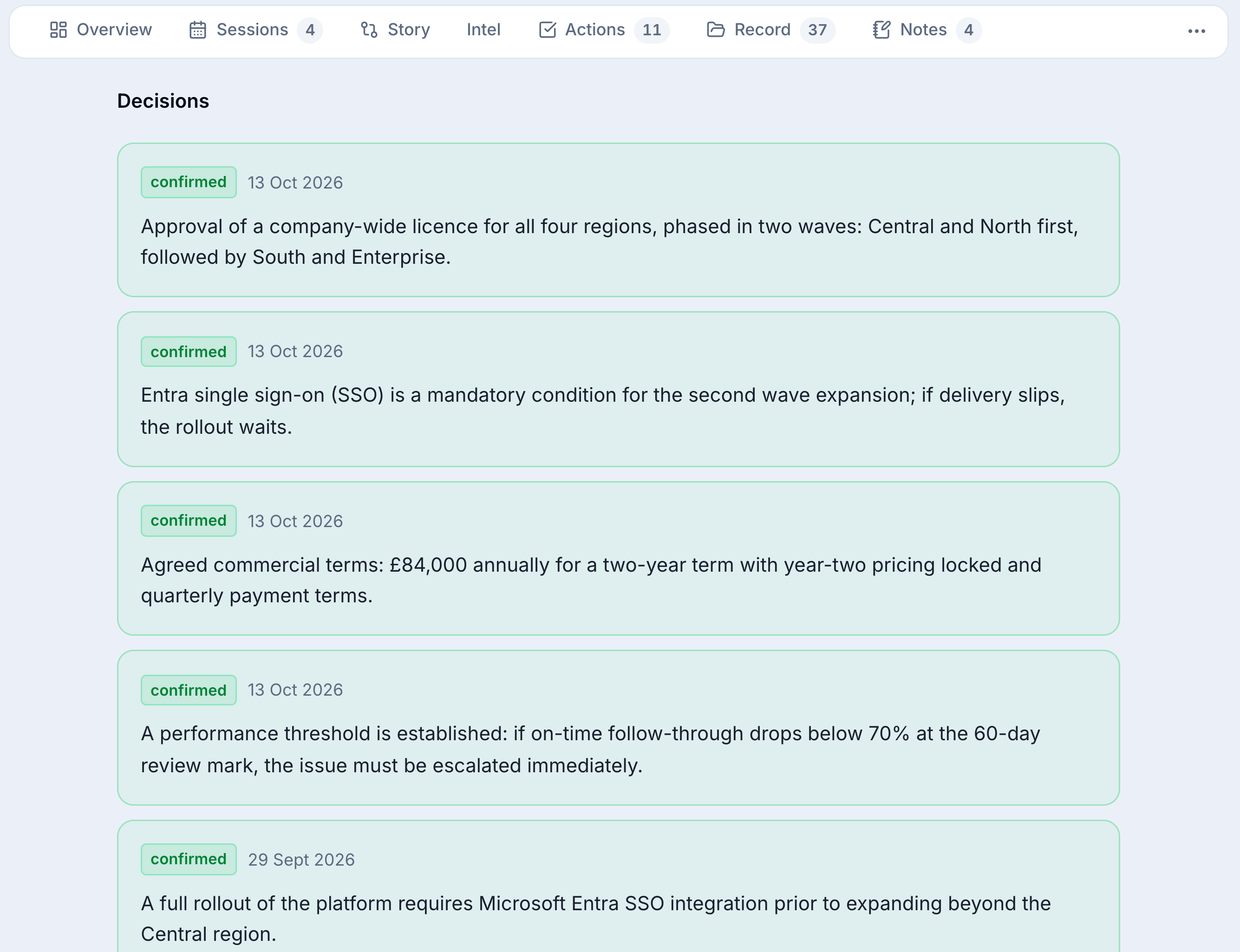
Up to five decisions per call with who took part and the line that records it. Notes typed as blocker, risk, context, observation.
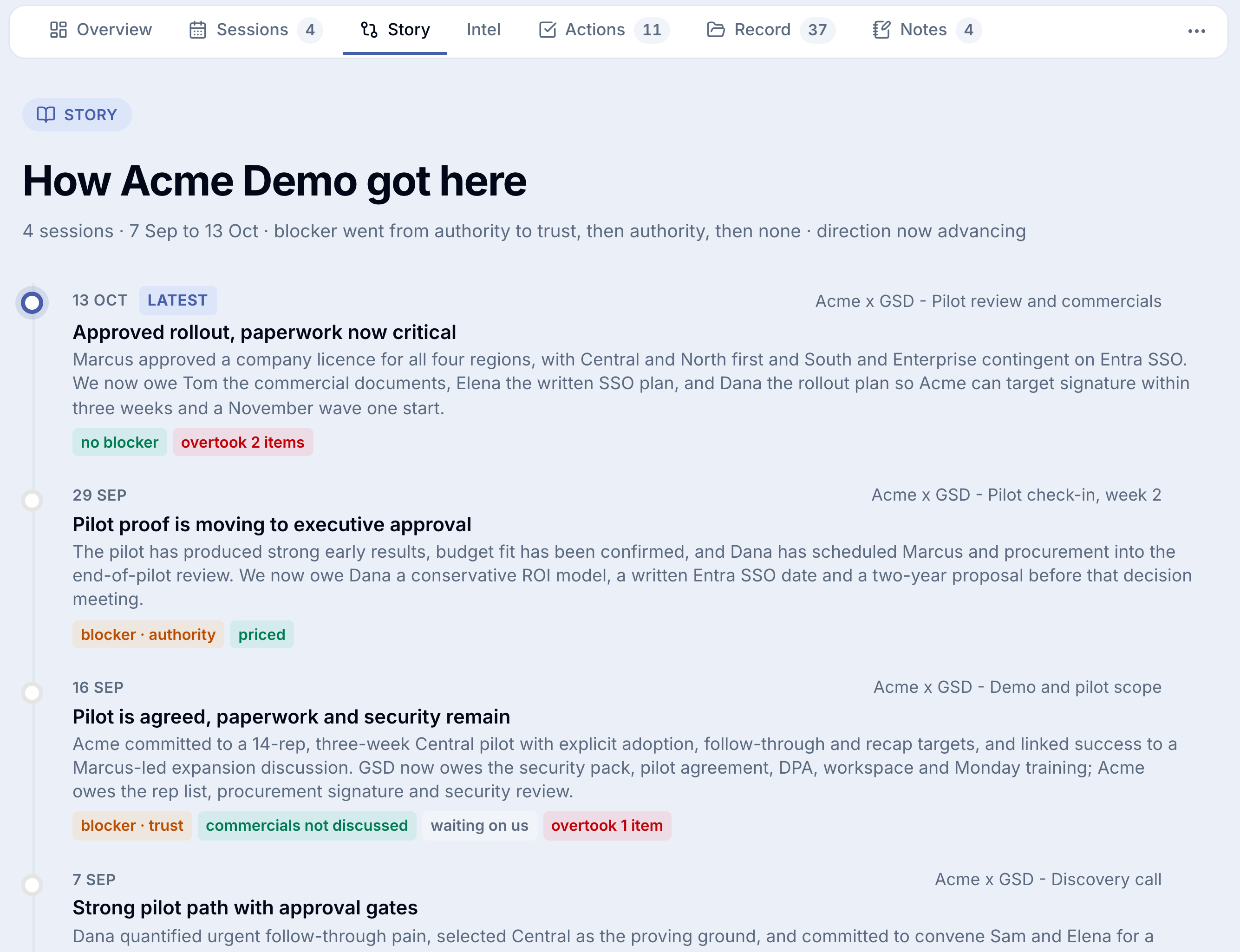
One node per session with what changed: direction, blocker, commercial shape, who's waiting, items overtaken.
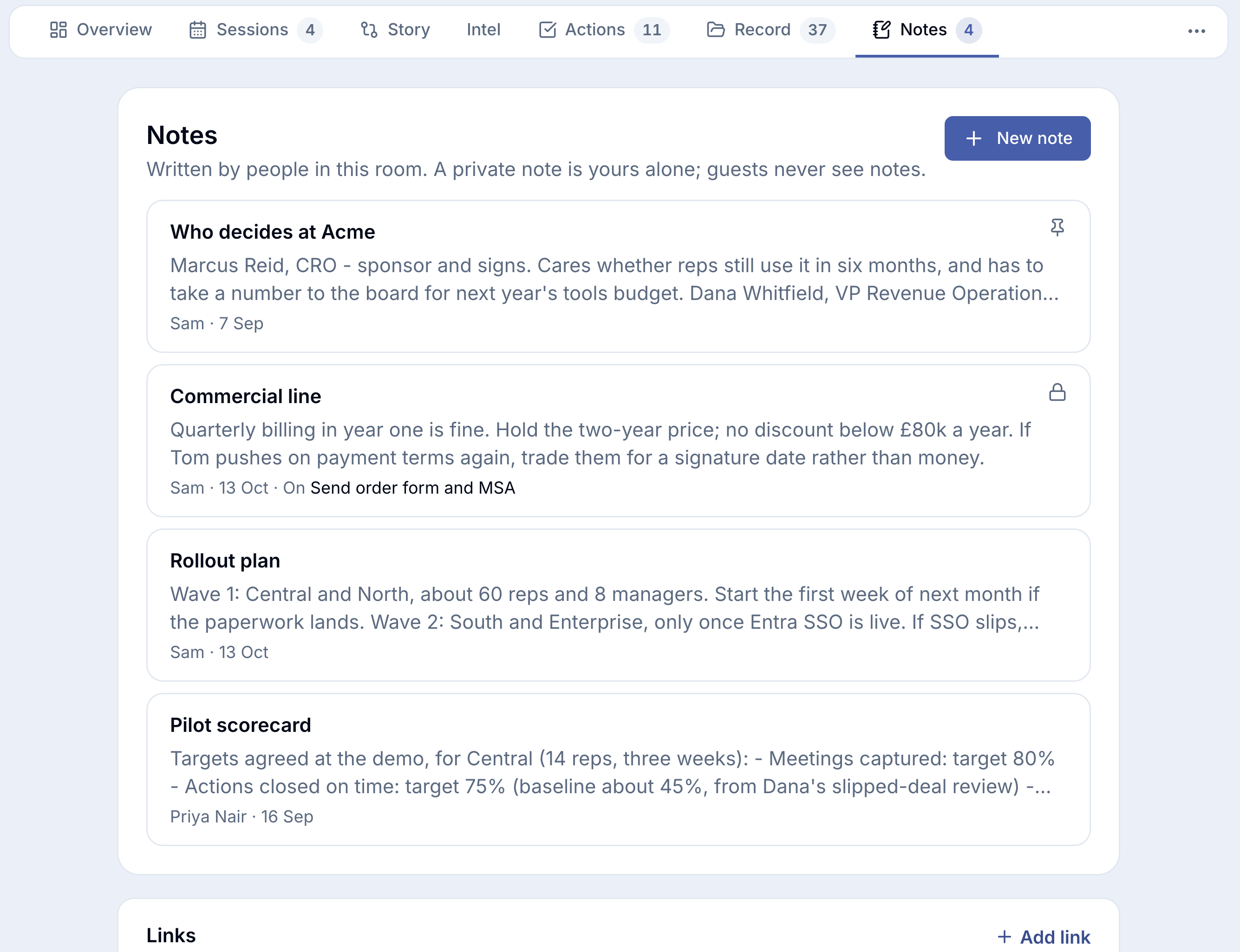
Notes people write, private or pinned. Record: what ran on what, source faults with one fix each, and Fix a name or spelling, everywhere, once.
Six signals, from the record only. Never a default.
Each dimension is green, amber or red, with a plain sentence saying why. Where there isn't enough evidence it says so instead of guessing. Red always carries its fix.
Client voice measures the client's share of words, never a rep's talk ratio. One of our own clients told us the last tool "ranked reps on talk ratio and the team hated it."
What your client gets. And only that.
A separate projection, not a filtered copy. Stage, value, risk, objections, internal notes and your next moves cannot reach it; a test checks for leaks on every change. You preview it as the client, edit any line, then send.
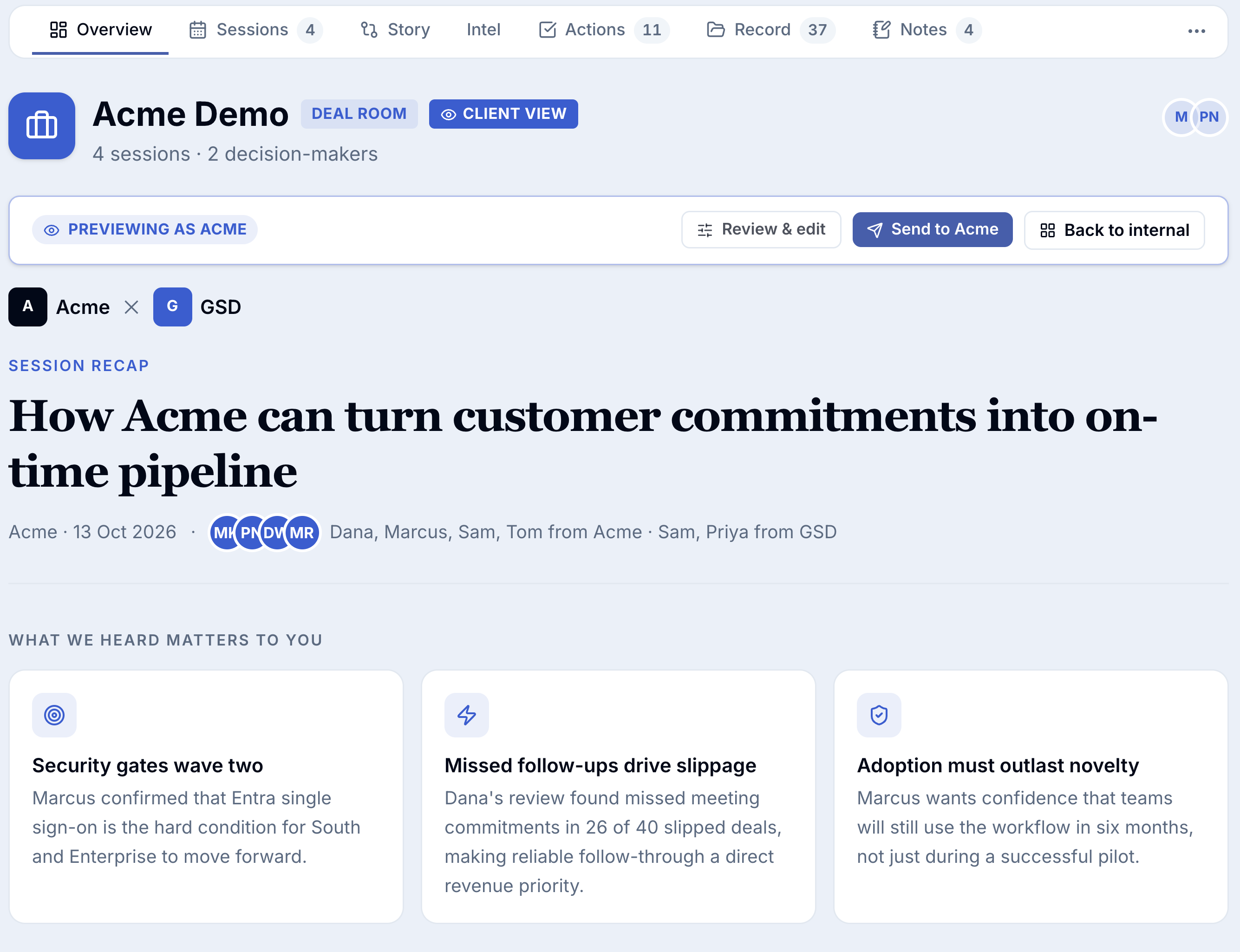
A recap they can act on, not a recording to scrub through.
What we heard matters to you. Value cards in the client's own terms.
Moments from the session. Verbatim quotes with speaker and context, an "Our commitment" badge, a proof link. You pick which go in.
Where we landed and what's next. Their items and yours, side by side, with owner and timing.
Their commitments, live. Each reader sees their own items and can accept, modify, push back, ask for more time or mark done. No account needed.
Your champion forwards the recap. Each reader picks a role and gets a 60-second brief for it, in the client's own words, with "Asked of IT" at the end. Every point traces to a moment.
A forwardable note drafted for your champion: the summary, why it matters, in Marcus's words, what happens next on both sides, what they need from colleagues, and a link to the full recap.
Sent, opened, acted, signed up, per recipient. Which proof links they clicked. "Marcus hasn't opened the recap, shared 4 days ago." Colleague links by name and role, withdrawable.
The pipeline reads itself, from the same records.
Every deal room feeds one pipeline. No one types a status. Today says which three deals to touch and why; Intel finds the patterns across deals.
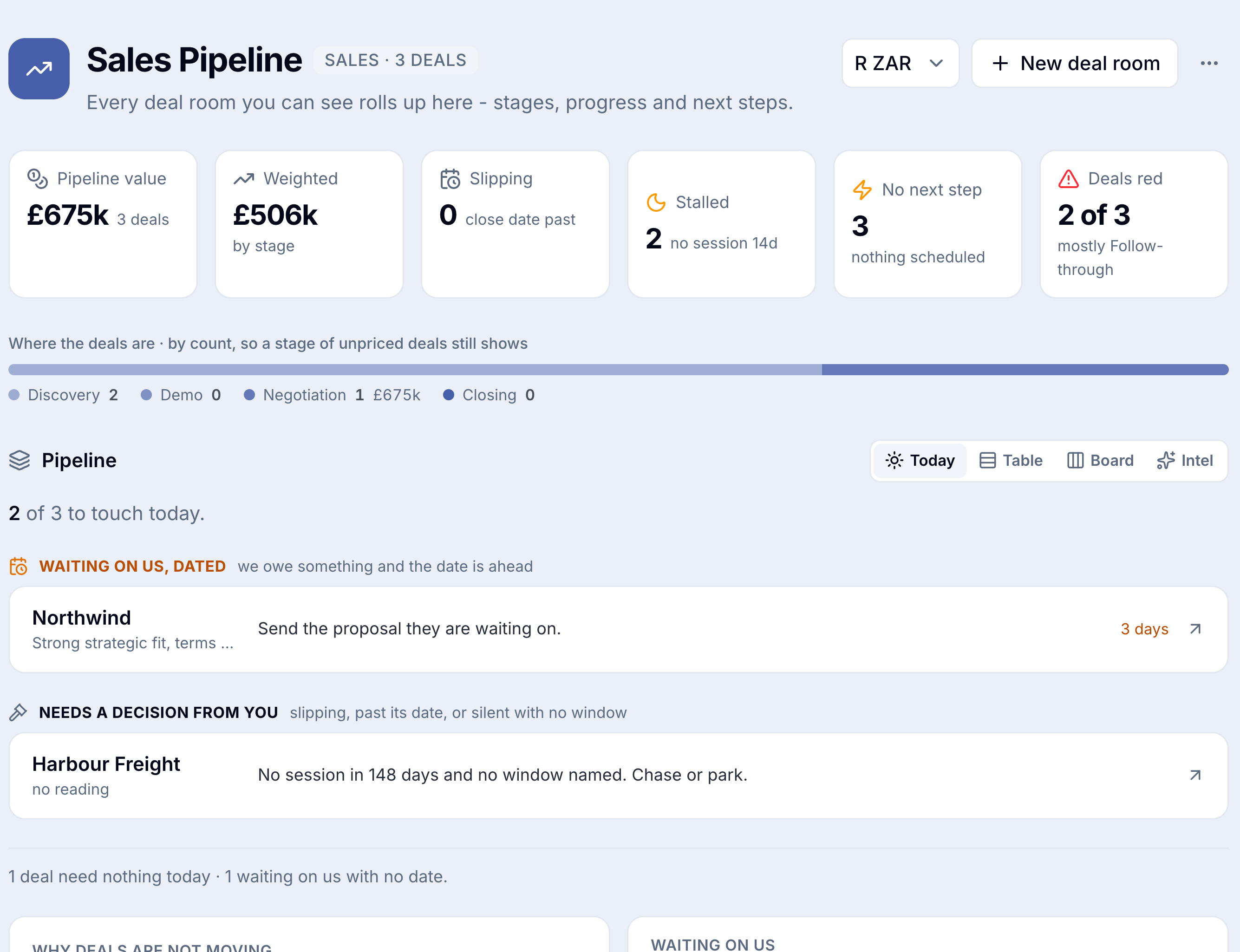
Windows opening, waiting on us, needs a decision from you. Then why deals are not moving.
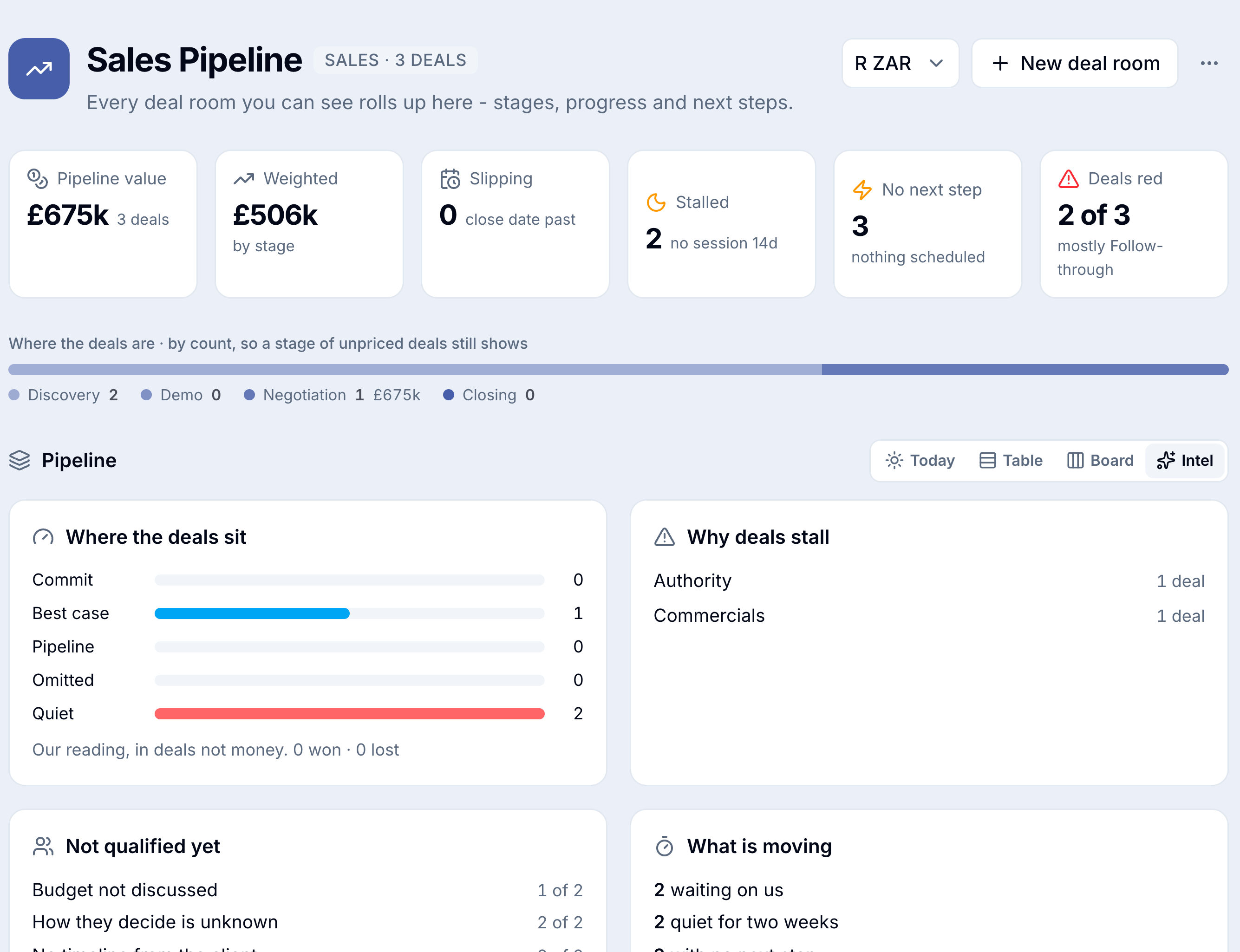
Where the deals sit, why they stall, what's not qualified yet, what is moving, patterns across deals.
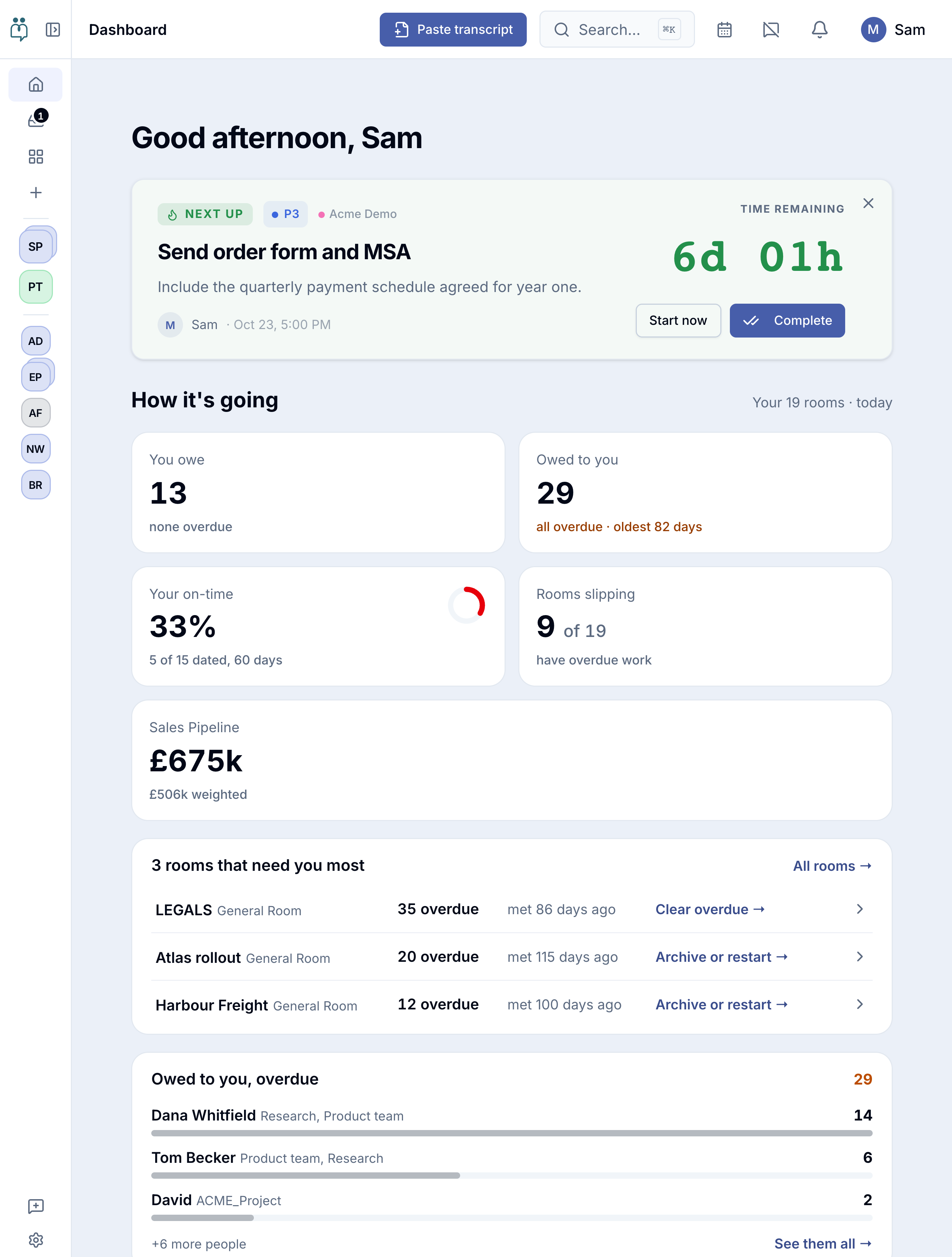
Who's waiting on you. Who you're waiting on. Before the first call.
One email a day, four sections: People are waiting on you, You're waiting on, Today, Not accepted yet. Built from the record with no AI in the loop, so it's the same list the Dashboard shows.

A week in sales, without and with.
The deal lives in one rep's head and a CRM note from three calls ago. The forecast call is twenty minutes of "where are we with Acme?"
Open the room: advancing, no blocker, waiting on us, and the next move. The forecast call is about the three deals Today says to touch.
6pm, still writing the client recap, checking twice that your margin notes didn't slip in.
The client recap is drafted from the call and can't carry internal lines. Preview it as the client, change a sentence, send.
The client said they'd confirm the tenant "before Tuesday". It's Thursday. Nobody wrote it down, so nobody chases.
It's an action on Dana with the words she said. Two days late shows in your briefing, with a polite nudge one click away.
of workers frequently leave meetings without a clear idea of next steps or who owns which task.1
of B2B purchases stall during the buying process.2
people shape a typical B2B buying decision: 13 inside the buyer, 9 outside. Your recap has to travel.3
1. Atlassian, Workplace Woes: Meetings Edition (2024). 2. Forrester, The State of Business Buying (2024). 3. Forrester, The State of Business Buying (2026).
Try it on your last sales call.
Paste the transcript. See the verdict, the next move, who decides and what you owe each other. Nothing reaches the client until you send it.
Paste, forward the recap email your recorder sends, or connect Fireflies, Zapier, Make, n8n or Plaud. One licence for the whole company.